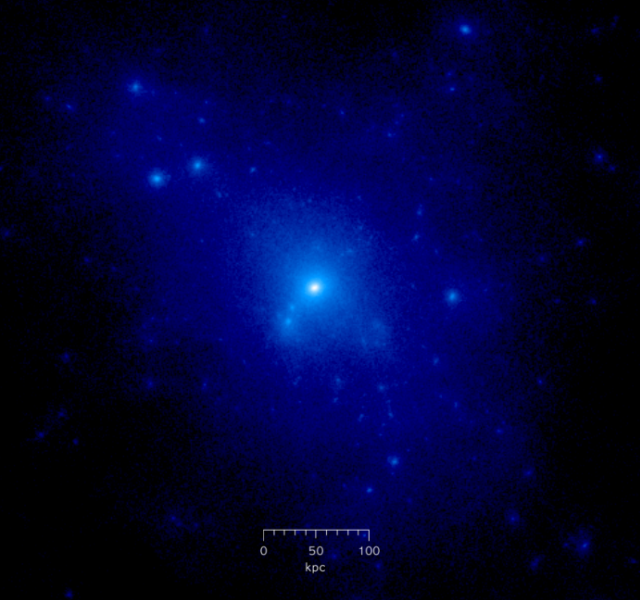
Author's note: I wrote this poem back in 1999. I am still fascinated by dark matter, and a recent story on a new theory of dark matter sparked my memory of this old sonnet (I was fascinated by the sonnet form for a while, too...).
Sonnet: To the Dark Matter
Something there is that yet still may not be:
Theories, conjectures, like folktales, abound;
Black mortar holding the bright tiles, for me:
Though ’tis concealed, amongst darkness be found.
In that abyss of the void in-between
Glistening gods man has too long revered
Lieth that crutch on which stars and spheres lean
(Key to a Nothing from which life appeared).
Look then, ye stargazers, upon that light
Wearied by lovers (like roses and dew!),
Thinking the luminous is the aright,
Certain that “Nothing there is!” is not true.
Nothing: it is that which I gaze upon,
Hiding itself ’neath the breaking of dawn.
Image credit: CosmoO, public domain image, via Wikimedia Commons.
Inspiration is a splinter, and sometimes the only pair of tweezers you have is writing.
Tuesday, June 11, 2013
Thursday, June 6, 2013
Review of On Their Own Terms by Lee Hall
It has been nearly 70 years since Donald Watson and others launched the Vegan Society, proclaiming to the world a radical idea: that humans had no right to use animals in any way, for any reason. Since then, many seminal thinkers and works have argued the case for animal rights. Peter Singer published Animal Liberation nearly 40 years ago, and we have for decades had available the works of theorists such as Tom Regan and Gary Francione. Through their work, and the work of countless “grassroots” activists of many forms, “animal rights” has become a term of general knowledge—though its connotations can vary drastically depending on the speaker and audience!
In recent years, and especially within recent months, people in the animal rights movement have begun to reflect publicly on the movement itself, assessing principles, practices, and future efforts. Of particular import in this reflection is the question of what kind of use of animals is acceptable…or is any use not acceptable at all?
This question has rippled through animal advocacy in all its forms, leading many to wonder if there are not two animal-focused movements (often being referred to as “abolitionist” and “welfarist,” depending on how the question is answered).
Thursday, December 27, 2012
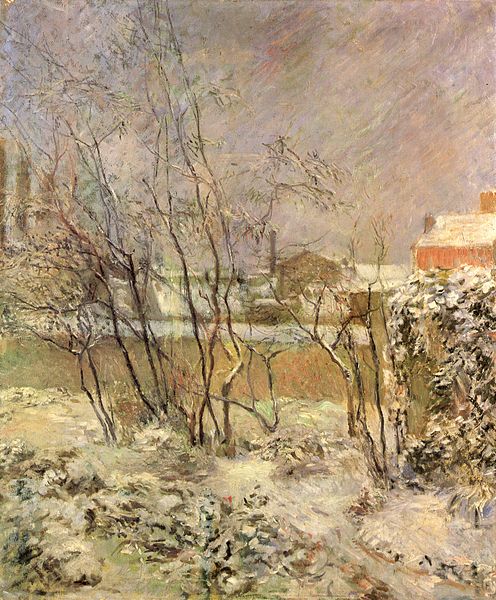
Winter Garden
Winter Garden
Skeletons stand up from a field
Of snow, stretching to a white horizon,
And shiver in this crackling cold
As Boreas blows implacably.
It is impossible to remake this landscape
Even with a painter’s vision
Or make those skeletons live again—
Though a prophet, perhaps, could do it.
Our memories of picking ripe fruits
Are still fresh, but with frozen edges,
And we wonder how those skeletons
Ever bore flesh, bore fruit, and thrived.
The season of our discontent has come
And frozen the flesh on our bones,
While we gaze through the windows
And remember, foreseeing, the green.
That green fire is buried now,
Hidden deep beneath the snow,
But still it flickers and flashes out
At times—if you happen to catch it.
For this boundless blanket of snow
Is a mask, not the true face of Death,
And the seeds of summer and fall
Are sleeping and dreaming of spring.
Image credit: Paul Gauguin, La neige Rue Carcel (I), from Wikimedia Commons, public domain image.
Skeletons stand up from a field
Of snow, stretching to a white horizon,
And shiver in this crackling cold
As Boreas blows implacably.
It is impossible to remake this landscape
Even with a painter’s vision
Or make those skeletons live again—
Though a prophet, perhaps, could do it.
Our memories of picking ripe fruits
Are still fresh, but with frozen edges,
And we wonder how those skeletons
Ever bore flesh, bore fruit, and thrived.
The season of our discontent has come
And frozen the flesh on our bones,
While we gaze through the windows
And remember, foreseeing, the green.
That green fire is buried now,
Hidden deep beneath the snow,
But still it flickers and flashes out
At times—if you happen to catch it.
For this boundless blanket of snow
Is a mask, not the true face of Death,
And the seeds of summer and fall
Are sleeping and dreaming of spring.
Image credit: Paul Gauguin, La neige Rue Carcel (I), from Wikimedia Commons, public domain image.
Monday, October 15, 2012
Nightmares
NightmaresUndone we are by the night of Time,
The
realm of Saturn and his awful sons,
Forever
fleeing from thunderbolts
And
an unforgiving razor scythe
Wherever
we may run and hide,
Unable,
unwilling to blink or breathe;
And
every breeze is the burning breath
Of
a better predator bringing death.
The
night is not ours to control,
Those
hours of unwilling return
To
primordial eons of living
Not
as predators but as prey,
The
slithering fear still lurking
At
the base of our swollen brains
And
in all those chilling whispers
That
are far too fast to outrun.
In
the darkest moments of terror,
Under
a boundless starless sky
And
a demoniac grinning moon,
The
Abyss is singing lullabies
That
steal every inkling of sleep,
And
evil creatures are skulking
Towards
Earth on broken paths
Of
fractured, faltering light.
When
daylight dies, the memories
Too
deep for evolution to touch
Awake
and bare their fangs, alive
Again
in the shadow of death;
And
then, in a neural flash, is gone
The
gauzy illusion of supremacy
That
we have created just to survive
In
the face of unconquerable death.
But
not long ago, in the night of Time,
We
were the hunkering prey,
And
we were the passing indigestion
Of
some smarter, faster beast,
And
we were the victims of Nature’s disinterest,
And
we were the scavenging vermin…
Now
haunting our dreams and memories
In
this night we can never escape.
Image credit: Christine Matthews, from Wikimedia Commons, under a Creative Commons License.
Monday, August 6, 2012
Burial
Burial
We buried her quietly in the front yard,
When the sun had set and the rain had ceased,
The dying light allowing us to dig
A shape just larger than the meager box
That held her body, several-hours cold,
Which we should never have a need to hold.
We had seen her, and her mate, as well
As many groups of children through the years,
The happy couple returning every year
To nest beside a creek, and waddle by
The same old busy streets, and stop to eat
Beneath some feeders in a neighbor’s yard.
And here they were, the family at this feast
So readily at hand, habituating them
To bear the presence of people all around,
When out of nowhere and without a care
One careless, reckless driver in a rush
Struck her, mother mallard, and just drove on…
“She’s dead,” I heard and looked upon
Her still and silent form cradled so tenderly,
Thus cradled while alive and as she died;
So light yet bearing all the weight of death,
She seemed as though asleep, but no—
She slept forever, dead by a single blow.
We sowed some sweet alyssum seeds upon her grave
And apologized in vain for our so-selfish race
While bearing all the weight of needless death,
Of all the suffering wrought by human hands
And the cold machines that we have built in vain
To keep their blood off of our blood-stained hands.
Image credit: Catherine Munro, from Wikimedia Commons, under a Creative Commons License.
Monday, July 30, 2012
On the Edge
On the Edge
The
edges creep in from time to time,
And
all the wild things
Sitting
on these borders
Step
over the line
Like
wicked spirits
Slinking
through a break
In
a fragile magic circle.
Things
get interesting
Out
there on the edge
Where
domestic and wild
Can
mingle for a while,
Swap
stories and reminisce
About
the good ol’ days
When
they were much closer.
Design
meets spontaneity
In
a fit of indecision,
A
weighing of desires
And
unforeseen consequences,
Until
architecture and engineering
Become
biological,
Entwined
in a double helix
And
fueled by the power
Of
a circling sun.
That
is all well and good
Out
there on the horizon,
To
be watched like a sunset
With
space in between.
But
the edges creep in,
Softly
like a butterfly
Slipping
on in through your skin,
Contracting
like concentric circles
Sucked
into a singularity,
Now
a bottomless black hole
With
the weight of a universe
Lodged
firmly, intently,
Right
between your eyes.
Here
the edges lie for a time,
Lodged
like a chrysalis
With
some strange creature inside,
Soon
to fly out to the edge of the world.
Image credit: Richard Webb, from Wikimedia Commons, under a Creative Commons License.
Sunday, April 22, 2012
Vegan for the Planet
Everyone knows that nature is in trouble, and humans are the main culprit. Since at least some of us recognize this truism, we so often hear messages about fighting climate change, followed by recommendations for pretty obvious lifestyle changes: drive less, use CFL bulbs, recycle, turn down our thermostats, buy local foods, and so on. While important, these common recommendations often miss something crucial.
No matter what else you do, if you are still eating animal products, then you are having a big—and ultimately unnecessary—impact on the planet in a variety of ways. (In case you do not know what “vegan” means, it refers to someone who does not intentionally use animal products in any way—be it for food, clothing, or what have you. So this means no meat, no eggs, no milk, no cheese, no fish, no honey, no silk, no fur, no leather.)
Notice I said vegan, not vegetarian. Besides continuing some of the most awful forms of animal exploitation through dairy and eggs, vegetarianism simply is not enough. Not even close. Dairy cows and egg-laying hens create plenty of environmental problems, besides their own serious ethical problems.
The reasons for the urgency of going vegan to fight climate change are numerous but fall into a few general categories.
We know that transportation and inefficient buildings contribute massive amounts of greenhouse gases to the atmosphere. And, unless you watch too much Fox News, you also know that all those greenhouse gases are warming our planet and having many weird, worrisome, and ultimately destructive consequences. But animal agriculture is a huge player in the greenhouse-gas game as well.
A report by the UN’s Food and Agriculture Organization from 2006 laid out some disturbing facts. The report, ominously titled Livestock’s Long Shadow, stated that livestock contributed 18% of total greenhouse gases, putting it above transportation as a net contributor. That 18% of total annual human-caused pollutants consisted of 9% of carbon dioxide, 37% of methane (which is about 20 times as potent as CO2), and 65% of nitrous oxide (which is 300 times as potent as CO2). So that 18% may look pretty benign…but when you break it down, it is kind of terrifying.
I know that these specific numbers can be controversial, so I will not dwell on them…or ask you to be convinced entirely by them. But let me give you a few very real examples of how animal agriculture affects animals, humans, and the planet.
In factory farms, which are modern industrial farms with lots of animals generally in confined spaces, animals frequently suffer from respiratory infections and other illnesses due to the poor air quality. Not to mention that the human workers suffer along with them, with approximately 70% of factory-farm workers contracting acute bronchitis.
Just as animal agriculture breeds hot, toxic air, so too does it harm water quality—and quantity. Farmed animals account for as much as half of water used in the U.S., and the Environmental Protection Agency has reported that waste from factory farms pollutes more water sources than any other industries combined. The toxins from animal waste are in part responsible for the dead zone where the Mississippi River meets the Gulf of Mexico, just to name one example.
All those animals worsen the air, worsen and slurp up the water, and also “consume” vast amounts of land. The USDA says that farmed animals use up 80% of agricultural land in this country; worldwide, they take up 30% of the Earth’s surface and 33% of its farmable land. Equally alarming, millions of acres of rainforest are burned to open up pasture for livestock—seven football-fields worth of land every minute. So in order to raise more livestock, we cut down trees and strip away nutrient-dense soil, making the land virtually worthless in short order.
Those billions of animals also have to eat. And eat they do…but in alarming ways. See, in our modern industrial version of husbandry, we feed roughly 70% of the grains grown here (including corn, soy, wheat, and rice) to livestock. Listen to that number again: 70%. Of plant foods that could be eaten by humans. But humans can eat farmed animals, so no need to worry, right? Think again. Animals are horribly inefficient protein sources. For every pound of flesh or secretion, three to ten pounds of grain are fed to farmed animals. So we are practically throwing away tons and tons of perfectly nutritious food. We would do better just to eat the grains ourselves—and send the excess (which there would be lots of) to starving populations around the globe, who are also going to be the biggest losers in the climate-change game. I have heard that the current amount of food grown in the world could feed as many as 10 billion people, if not diverted to farm animals and if we were better about waste.
Now you may be thinking to yourself, “Sure, industrialized factory farming is bad. I get that. No problem. But I always buy grass-fed beef, and cage-free eggs, so all the animals who give me food are happy and healthy, not eco-terrors.” This sort of thinking is widespread today, especially with the rise of locavorism, the foodie movement, and prominent “humane” animal-farmers, like Joel Salatin of Polyface Farms to name the most famous.
Unfortunately, it is wrong. Yes, animals raised on small-scale family farms have different experiences than those raised in factory farms. But they are still objectified. They are prematurely slaughtered when they are at prime weight and meat quality instead of dying in their old age, and they are sent to the same slaughterhouses as factory-farmed animals. They also are genetically altered for the benefit of humans no matter the effects on the animals themselves—such as broiler chickens who grow so quickly that their muscles cannot keep up, leaving them crippled and prone to heart attacks. Plus, laughable labeling requirements make terms like “free-range” and “cage-free” and “humane” virtually meaningless. How can opening the tiny door of a chicken warehouse for a few hours a day be called “free-range”? Ask the USDA.
These “humanely raised” animals also still harm the environment. Most significantly, those grass-fed cattle may be more “natural,” but they also produce around twice as much greenhouse gas as their grain-fed counterparts and require much more land. And just because an animal product is local does not make it better for the environment. Because the production of animal foods, not their transportation, consumes the most fossil fuels and creates the most greenhouse gases, you do better for the environment by going vegan than by eating a 100-mile (or less) diet.
The saddest part of all is that this comes down to human choice. We are not, whatever Dr. Atkins and Paula Deen and the time-travelers from the Paleolithic Era might have told you, required to eat meat or any other animal product. Not a one. Millions of years of evolution left us as omnivores, not obligate carnivores. We can live perfectly healthy, happy, active lives without ever consuming a single ounce of animal protein. People have been doing it for years. I have been vegan for over 14 years, and I am a newbie compared to some other prominent vegans, who did it before the movement became a trend and before you could find vegan-friendly foods in your local grocery store. You can choose what you eat. Yes, you can.
And if you really care about the Earth, you must. You can bike, you can recycle, you can light up your life with CFLs, but unless you go vegan you are not doing enough.
Not only is it about the statistics, and the data, and the science. Those are readily available and overwhelmingly damning of animal agriculture. But it is also about the vision and model that we who care about the planet want to set for our global society, and for our local community as well. I believe that we humans cannot be stewards or saviors, but instead must recognize our place with all the other creatures in the biosphere. We must recognize and celebrate our interconnections and interdependencies, not try to master nature with our technologies and our hubris. That, as our wisest myths and stories tell us, is always a recipe for disaster. And the Earth is showing it to us right now.
No matter what else you do, if you are still eating animal products, then you are having a big—and ultimately unnecessary—impact on the planet in a variety of ways. (In case you do not know what “vegan” means, it refers to someone who does not intentionally use animal products in any way—be it for food, clothing, or what have you. So this means no meat, no eggs, no milk, no cheese, no fish, no honey, no silk, no fur, no leather.)
Notice I said vegan, not vegetarian. Besides continuing some of the most awful forms of animal exploitation through dairy and eggs, vegetarianism simply is not enough. Not even close. Dairy cows and egg-laying hens create plenty of environmental problems, besides their own serious ethical problems.
The reasons for the urgency of going vegan to fight climate change are numerous but fall into a few general categories.
We know that transportation and inefficient buildings contribute massive amounts of greenhouse gases to the atmosphere. And, unless you watch too much Fox News, you also know that all those greenhouse gases are warming our planet and having many weird, worrisome, and ultimately destructive consequences. But animal agriculture is a huge player in the greenhouse-gas game as well.
A report by the UN’s Food and Agriculture Organization from 2006 laid out some disturbing facts. The report, ominously titled Livestock’s Long Shadow, stated that livestock contributed 18% of total greenhouse gases, putting it above transportation as a net contributor. That 18% of total annual human-caused pollutants consisted of 9% of carbon dioxide, 37% of methane (which is about 20 times as potent as CO2), and 65% of nitrous oxide (which is 300 times as potent as CO2). So that 18% may look pretty benign…but when you break it down, it is kind of terrifying.
I know that these specific numbers can be controversial, so I will not dwell on them…or ask you to be convinced entirely by them. But let me give you a few very real examples of how animal agriculture affects animals, humans, and the planet.
In factory farms, which are modern industrial farms with lots of animals generally in confined spaces, animals frequently suffer from respiratory infections and other illnesses due to the poor air quality. Not to mention that the human workers suffer along with them, with approximately 70% of factory-farm workers contracting acute bronchitis.
Just as animal agriculture breeds hot, toxic air, so too does it harm water quality—and quantity. Farmed animals account for as much as half of water used in the U.S., and the Environmental Protection Agency has reported that waste from factory farms pollutes more water sources than any other industries combined. The toxins from animal waste are in part responsible for the dead zone where the Mississippi River meets the Gulf of Mexico, just to name one example.
All those animals worsen the air, worsen and slurp up the water, and also “consume” vast amounts of land. The USDA says that farmed animals use up 80% of agricultural land in this country; worldwide, they take up 30% of the Earth’s surface and 33% of its farmable land. Equally alarming, millions of acres of rainforest are burned to open up pasture for livestock—seven football-fields worth of land every minute. So in order to raise more livestock, we cut down trees and strip away nutrient-dense soil, making the land virtually worthless in short order.
Those billions of animals also have to eat. And eat they do…but in alarming ways. See, in our modern industrial version of husbandry, we feed roughly 70% of the grains grown here (including corn, soy, wheat, and rice) to livestock. Listen to that number again: 70%. Of plant foods that could be eaten by humans. But humans can eat farmed animals, so no need to worry, right? Think again. Animals are horribly inefficient protein sources. For every pound of flesh or secretion, three to ten pounds of grain are fed to farmed animals. So we are practically throwing away tons and tons of perfectly nutritious food. We would do better just to eat the grains ourselves—and send the excess (which there would be lots of) to starving populations around the globe, who are also going to be the biggest losers in the climate-change game. I have heard that the current amount of food grown in the world could feed as many as 10 billion people, if not diverted to farm animals and if we were better about waste.
Now you may be thinking to yourself, “Sure, industrialized factory farming is bad. I get that. No problem. But I always buy grass-fed beef, and cage-free eggs, so all the animals who give me food are happy and healthy, not eco-terrors.” This sort of thinking is widespread today, especially with the rise of locavorism, the foodie movement, and prominent “humane” animal-farmers, like Joel Salatin of Polyface Farms to name the most famous.
Unfortunately, it is wrong. Yes, animals raised on small-scale family farms have different experiences than those raised in factory farms. But they are still objectified. They are prematurely slaughtered when they are at prime weight and meat quality instead of dying in their old age, and they are sent to the same slaughterhouses as factory-farmed animals. They also are genetically altered for the benefit of humans no matter the effects on the animals themselves—such as broiler chickens who grow so quickly that their muscles cannot keep up, leaving them crippled and prone to heart attacks. Plus, laughable labeling requirements make terms like “free-range” and “cage-free” and “humane” virtually meaningless. How can opening the tiny door of a chicken warehouse for a few hours a day be called “free-range”? Ask the USDA.
These “humanely raised” animals also still harm the environment. Most significantly, those grass-fed cattle may be more “natural,” but they also produce around twice as much greenhouse gas as their grain-fed counterparts and require much more land. And just because an animal product is local does not make it better for the environment. Because the production of animal foods, not their transportation, consumes the most fossil fuels and creates the most greenhouse gases, you do better for the environment by going vegan than by eating a 100-mile (or less) diet.
The saddest part of all is that this comes down to human choice. We are not, whatever Dr. Atkins and Paula Deen and the time-travelers from the Paleolithic Era might have told you, required to eat meat or any other animal product. Not a one. Millions of years of evolution left us as omnivores, not obligate carnivores. We can live perfectly healthy, happy, active lives without ever consuming a single ounce of animal protein. People have been doing it for years. I have been vegan for over 14 years, and I am a newbie compared to some other prominent vegans, who did it before the movement became a trend and before you could find vegan-friendly foods in your local grocery store. You can choose what you eat. Yes, you can.
And if you really care about the Earth, you must. You can bike, you can recycle, you can light up your life with CFLs, but unless you go vegan you are not doing enough.
Not only is it about the statistics, and the data, and the science. Those are readily available and overwhelmingly damning of animal agriculture. But it is also about the vision and model that we who care about the planet want to set for our global society, and for our local community as well. I believe that we humans cannot be stewards or saviors, but instead must recognize our place with all the other creatures in the biosphere. We must recognize and celebrate our interconnections and interdependencies, not try to master nature with our technologies and our hubris. That, as our wisest myths and stories tell us, is always a recipe for disaster. And the Earth is showing it to us right now.
-
Food and Agriculture Organization, Livestock’s
Long Shadow: http://www.fao.org/docrep/010/a0701e/a0701e00.HTM.
-
Jonathan Safran Foer, Eating Animals:
http://www.amazon.com/Eating-Animals-Jonathan-Safran-Foer/dp/0316069884/ref=sr_1_1?ie=UTF8&qid=1334625933&sr=8-1.
-
Humane Society of the United States, Farm Animal Protection documents: http://www.humanesociety.org/issues/campaigns/factory_farming/.
-
Farm Sanctuary, Factory Farming documents: http://farmsanctuary.org/issues/factoryfarming/.
-
James E. McWilliams, “The Myth of Sustainable Meat”: http://www.nytimes.com/2012/04/13/opinion/the-myth-of-sustainable-meat.html?ref=opinion.
(Also see his blog, http://eatingplantsdotorg.wordpress.com/.)
Subscribe to:
Posts (Atom)
.jpg)